An AI-powered data extraction, transforming weeks of document review into powerful and trusted insights.
DETAILS
Medical records are a law firm's most critical asset, yet they represent their largest operational bottleneck. My research revealed that teams were losing 15–20 billable hours per case to manual discovery, a process that was not only slow but prone to human error that could undervalue a settlement by thousands.
My mission was to transform Litify from a record-storage tool into an AI-driven insights engine. I led the design of an automated extraction system that converts thousands of pages of unstructured PDFs into a verified, strategic narrative, reducing time-to-insight by over 80%.
ROLE
Senior Product Designer, AI and Core Practice Management | Litify | 2025
Strategic Design Vision and Roadmapping, AI-Driven Design, Stakeholder Alignment, End to End Design, Prototyping, User Research and Testing
The Challenge
Legal teams operate in a high-stakes environment where a single data error can lead to a dismissed case or a million-dollar malpractice suit. My challenge was to transform an opaque, manual review process into an automated system that users could trust implicitly.
User Research
To build a successful AI-driven tool in a risk-averse industry, I initiated a multi-phase research strategy focused on understanding the psychological and operational barriers to AI adoption in legal workflows. I used the following research methods:
Contextual Inquiry: Observed 12 paralegals and attorneys across 5 clients to map the manual taxonomy they used when highlighting physical records.
Gap Analysis: Identified that users weren't just looking for data extraction; they were looking for narrative validation. If the AI couldn't prove why it reached a conclusion, the tool would be abandoned for Excel.
Competitive Benchmarking: Evaluated other legal-tech tools to identify why their AI implementations failed to gain traction.
My research shifted our North Star from Automated Summarization to Verifiable Intelligence. We realized the value wasn't just in the AI's speed, but in the interface’s ability to provide instant traceability to the source material.
Strategic Insights
Early on, I realized the biggest risk wasn't the AI's speed, it was the trust gap. Lawyers are skeptical of AI, as a single error in a medical chronology could jeopardize a million-dollar case. If they couldn't see the receipts, they’d stick to manual Excel sheets. Instead of just a summary tool, I architected a verification engine. I pushed for a traceability-first flow, linking every AI data point to its exact line in a 1,000-page source PDF. The real aha moment was the Strategic Flagging feature. I designed logic that didn't just extract data, but surfaced any smoking guns in their case: auto-flagging gaps in treatment or pre-existing conditions that directly impact settlement value. By designing for this Exception Path (making it easy to audit and highlight critical wins), we turned a risky AI tool into a defensible litigation asset. This shift from simple automation to strategic insight became our primary competitive advantage.
The Solution
Instead of a static document, I designed a dynamic chronology product that transforms thousands of pages of raw medical data into a verifiable strategic narrative. By integrating AI-driven extraction with a "Human-in-the-Loop" validation framework, the solution allows legal teams to move from data ingestion to case strategy 90% faster while maintaining 100% evidentiary integrity.

The Chronology View
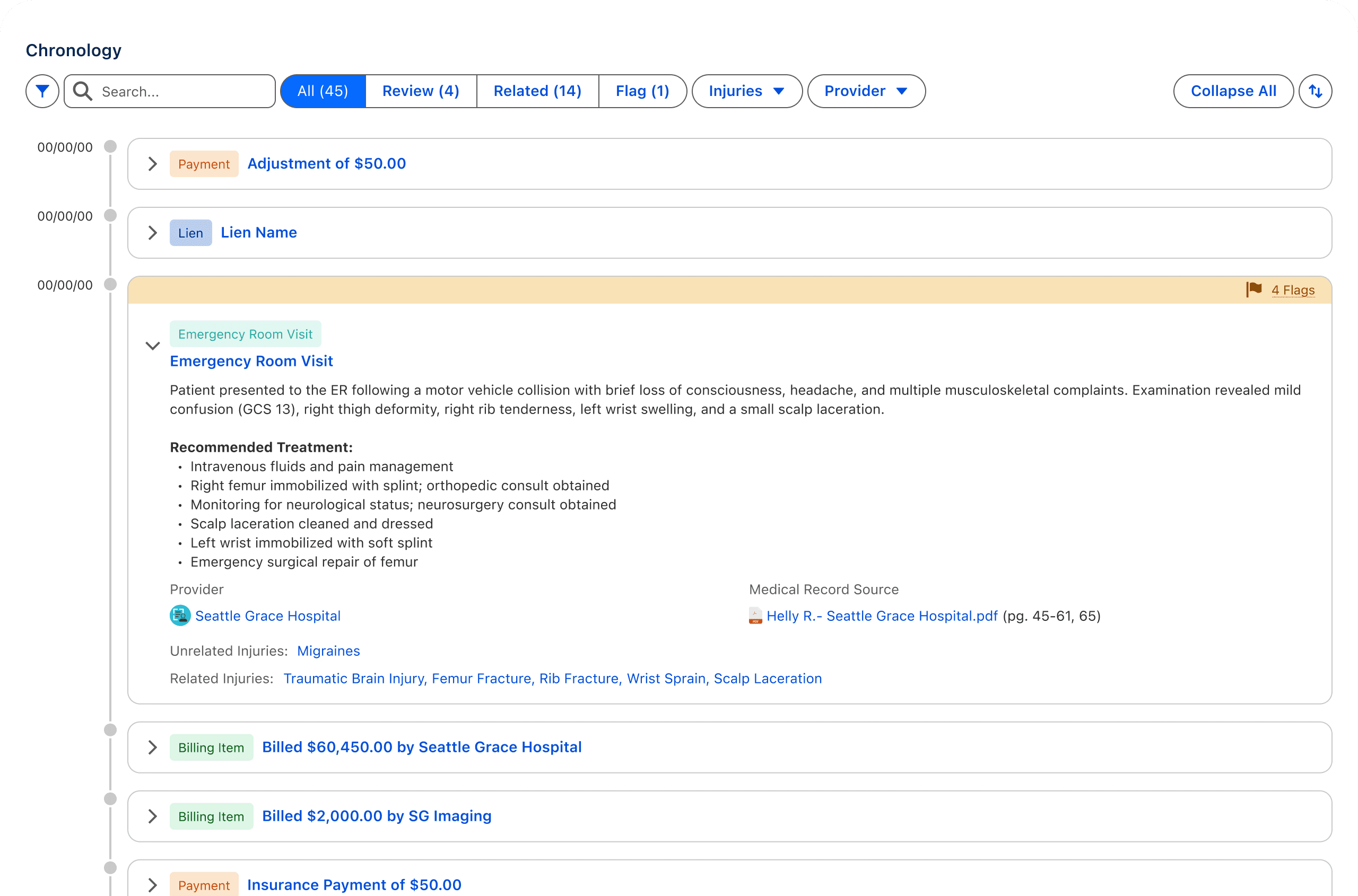
I designed a view that condensed hundreds of pages of records into an easily scannable, interactive timeline. Users can drill into any AI-extracted event to see supporting details and instantly jump to the exact page in the source PDF.

Strategic Insights & Flagging
I architected a smart-flagging system configured to help users quickly assess and validate the information that matters most to the case value. Beyond simple extraction, the UI auto-surfaces alerts, such as gaps in treatment or pre-existing conditions, allowing attorneys to focus on high-value litigation strategy rather than manual data entry.

Trust-First Review Workflow
To neutralize concerns around AI hallucinations, I implemented a clear and efficient review process that empowers users to validate AI-assisted outputs. This "Validation Gate" ensures that every data point in the final chronology is user-verified, upholding absolute trust throughout the high-stakes legal workflow.
Usability Testing
Testing was not just about UI polish; it was a rigorous validation of our Human-in-the-Loop philosophy. I led multiple rounds of moderated testing with 20+ legal professionals to ensure our AI-driven insights could withstand the scrutiny of a high-stakes litigation environment. Our testing strategy:
Trust First Review Workflow: We specifically tested the Click-to-Evidence feature by asking users to find the source of a complex medical diagnosis within a 1,000-page record. We measured a 90% reduction in verification time, moving from minutes of manual searching to a single click.
Validation of Strategic Flagging: I observed how attorneys interacted with the flags. Testing revealed that these flags didn't just save time, they fundamentally changed the user’s cognitive load, allowing them to shift from searching for data to building a legal argument immediately upon opening the file.
Iterative Feedback Loops: Through weekly sessions with design partners and stakeholders, we refined the Injury Ledger logic. This ensured that the automated grouping of related injuries (e.g., linking a wrist sprain to an ER visit) aligned with how a trial lawyer would present a case in court.
The Outcome
The impact of this tool was immediate: we successfully reduced the time it takes to generate a medical chronology from hours of grueling manual labor down to just minutes. By automating the extraction of key dates and injuries with 95% accuracy, we empowered attorneys to pivot their focus toward high-value legal strategy rather than tedious data entry. This didn't just improve internal firm efficiency, it accelerated the entire path to settlement, getting clients the help they need significantly faster than the traditional process allowed. Beyond the technical metrics, the high-fidelity prototypes I developed were so compelling and grounded in user truth that they served as a powerful sales tool, securing client buy-in and 'selling' the product before a single line of code was even released.
"Emily's prototypes made the demo seamless and compelling enough to sell the client on a product that hadn’t even been built yet. Her knowledge of our customer base, users, and competitors has helped us move at a rapid pace and make quick design decisions to propel us forward!"
Sarah
VP Product @Litify