An AI-generative drafting assistant that captures a firm’s unique voice to produce legal documents in minutes.
DETAILS
Attorneys spend a significant portion of their day on routine drafting, but generic AI outputs often fail to meet the rigorous standards of legal formatting and tone.
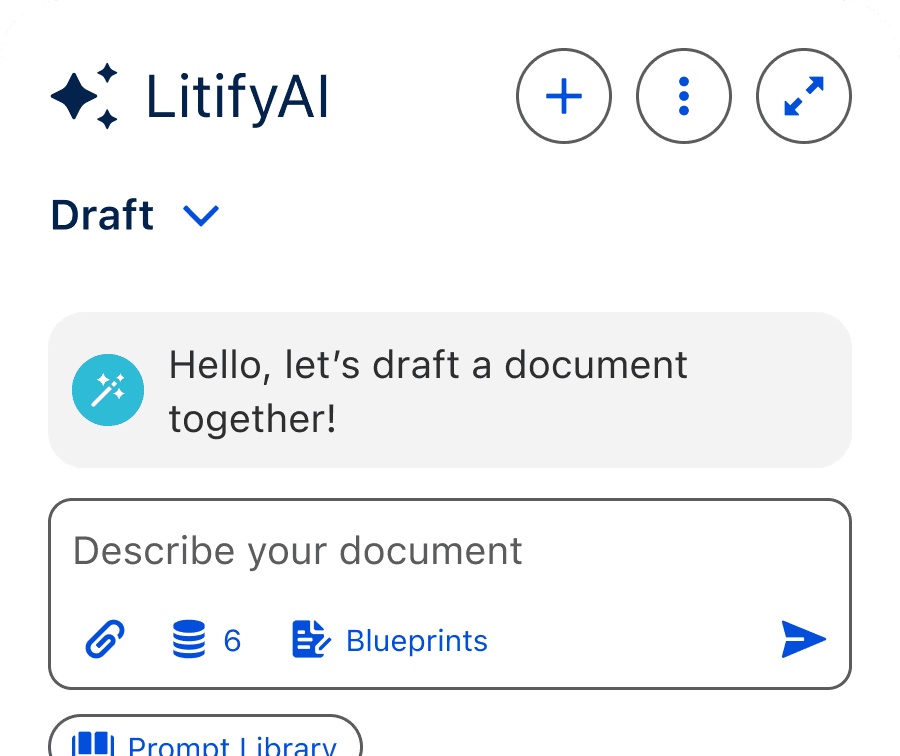
My goal was to move beyond a standard chatbot interface to create a context-aware drafting engine. I led the design of "Blueprints," a system that allows AI to adopt a firm's specific "voice" and formatting standards, reducing draft time, while ensuring 100% compliance with jurisdictional requirements.
ROLE
Senior Product Designer, AI and Core Practice Management | Litify | 2025
Strategic Design Vision and Roadmapping, AI-Driven Design, Stakeholder Alignment, End to End Design, Prototyping, User Research and Testing
The Challenge
We discovered that while law firms wanted the efficiency of AI, strict data privacy and the fear of generic output were major adoption barriers. Additionally, every law firm has a unique stylistic "fingerprint." A generic AI draft actually increases work if the attorney has to rewrite it to match their style. I had to design a way for the AI to "learn" from a firm's existing document library without compromising data integrity.
Strategic Insights
My research revealed a critical misalignment in the initial product assumptions: drafting the text wasn't the primary bottleneck, re-formatting was. Legal documents must adhere to rigid jurisdictional and firm-specific standards, that vary by case type and document type. We discovered that if the AI’s output required manual adjustment of formatting, we would face a near-zero adoption rate. Paralegals and attorneys simply won't use a tool that creates 'extra work' in the final mile of document preparation. I shifted the focus from a standard 'Chat' interface to a 'Template-first' architecture. This led to the creation of Blueprints, where users select existing 'gold-standard' documents to serve as formatting guides. By ensuring the AI adopts the firm's specific 'visual voice' from the start, we transformed a potential adoption failure into a seamless, court-ready drafting engine.
The Solution
Instead of a generic AI text generator, I architected an intelligent ecosystem that uses a firm’s gold-standard work as its foundation. The core is a framework we called "Blueprints," which acts as a bridge between AI and the strict stylistic demands of legal work by using existing documents as formatting guides. I also designed a Source-Grounded Accuracy UI that lets attorneys instantly audit the AI's logic against original case data. By solving for the final mile of formatting and trust, we transformed a potential liability into a high-fidelity, court-ready asset

Blueprints
I architected the "Blueprints" feature to allow users to select gold-standard documents from past cases to serve as structural guides . This ensures that the AI-generated output matches the firm’s specific margins, headers, and citation styles from the start, bypassing the formatting hurdles that typically lead to product abandonment .

Source-Grounded Accuracy
To address the industry's Zero-Trust requirement, I designed a verification UI that explicitly links generated text to its underlying case data . This allows attorneys to audit the AI's logic instantly, ensuring that names, dates, and figures are accurate and reliable before the document is finalized
"Emily’s product knowledge, technical expertise, and UX expertise make her a triple threat. She’s essential in shaping our North Star vision for how Litify’s AI products come together as an ecosystem."
Liz
Director of AI Product and Commercialization @ Litify